
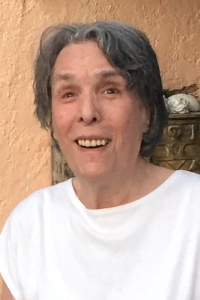
Helen Sidman
Helen Reeder Sidman passed away at home in Dedham, Massachusetts on September 17, 2026 at age 91, surrounded by friends and loved ones. In her final days, a Jewish chaplain sang and read to her, for which both Helen and her family expressed thanks. Helen had resided in Dedham since 2013, with support and care from her son Andrew. He joins friends and family in mourning her passing after a long struggle with memory and mobility issues.
Helen was born in 1935 in New York City, but grew up mainly in New Cumberland, a suburb across the Susquehanna River from downtown Harrisburg, Pennsylvania. There, she lived with her parents Ray and Robert, and younger brother, Bob. Helen grew especially close to her mother while her father served in the U.S. Army during World War II. After graduating from Harrisburg Academy in 1952, Helen attended Pennsylvania State University. She found that experience unfulfilling and left without a degree, but formed long-lasting friendships there. After leaving Penn State, she became a writer and researcher for the then-Governor of Pennsylvania, George M. Leader from 1956 to 1958.
Helen then moved to Boston, became involved in Democratic party politics, and subsequently married Lester Hyman, a lawyer who later served as the Democratic State Chairman. Helen carried three children to birth: David Hyman in 1960, Andrew Hyman in 1962, and Elizabeth Hyman in 1966, all of whom grew up under the care of Helen and Lester, although their marriage would end in divorce many years later.
In the early 1960s, Helen and her young family lived in Marshfield, Massachusetts on the South Shore. Alongside her role as a mom, she became active in the Civil Rights Movement. She served on the Boston branch of the NAACP, founded the South Shore Branch of the NAACP, and undertook civil rights work in Mississippi. To the end of her life, she remained deeply gratified to have taken part in that important movement.
In 1969, Helen and her family moved to Washington D.C., where she continued her involvement in public affairs. Her paid work included setting up a Right to Read Conference for the Washington Technical Institute, then producing the Airlie House Conference on Revenue Sharing for the National Urban Coalition, and later joining George McGovern’s 1972 presidential campaign. For the McGovern campaign, she and her staff organized pro-McGovern citizen groups throughout the country.
Her work experience in public policy strengthened her interest in the law, and was also sufficiently impressive that she was admitted in 1973 to Catholic University Law School despite not having a college degree. She graduated with a juris doctor degree in 1976. That same year, Helen and her family winterized what had for a decade been their summer house in the southern Berkshires of Massachusetts, and she started a solo law practice there. Her work included appearances in probate and district courts, on matters involving domestic relations, contracts, misdemeanors, and realty (she also held a real estate broker’s license). All of that she did while parenting.
After her marriage ended in 1979, Helen moved back to where so many of her early and influential experiences had taken place: Boston. She enjoyed living in the heart of the city on St. Botolph Street, for 33 years. She built an active life there, both personally and professionally. Her work included Care and Protection Investigations for several state district courts; arranging a 1982 symposium for the Lawyers Alliance for Nuclear Arms Control; and, organizing a 1984 seminar for state trial judges on behalf of the Franklin N. Flaschner Judicial Institute. She also served as Vice President and counsel at JRS Equities, Inc. and then at Intrust Technologies until 1986, and was given several appointments as guardian ad litem into the 1990s.
Helen was not all work and no play. She loved walking around Boston, not to mention going to Symphony Hall with her pals to enjoy the music (season tickets courtesy of her father Robert). She cherished summer trips to the Cape, not so much for the ocean as for time spent with friends at a shared lakeside cottage. Because living in Boston was expensive, she supplemented her income by running a small B&B at her condo on St. Botolph Street. During those years, she also enjoyed traveling abroad, for example journeying to the Spanish island of Majorca for an archeological dig, and to Poland (the birthplace of her maternal grandparents) where she found a warm welcome.
After moving to Dedham in 2013, Helen traveled less, but appreciated a week spent with her son Andrew at her former husband’s picturesque house in the British Virgin Islands, while he was not using it. She convinced the groundskeeper, George, to drive her all around the mountainous island of Tortola (which Andrew had already seen). The accompanying photo of Helen is from that trip. She loved spending time with friends and neighbors in Dedham, although socializing became more difficult and infrequent as she moved through her 80s into her 90s. She greatly appreciated the aid of her caregivers, including Lili, Nuke, Denise, Anne Marie, and Amanda (who rarely met because they came for a few hours on different days).
Helen’s was not a life without regret, but it was also a happy life. She had a deep emotional attachment to her mother both during and after Ray’s life, and perhaps they are together again now. Helen was saddened by a degree of estrangement within her own family, partly because of a difficult marriage that ended in divorce. But she also knew friendship, purpose, accomplishment, and happy times throughout her long and productive life. Besides her three children, she is survived by two nephews, David in Australia and Michael in Ohio, as well as their children.
Aleha hashalom.